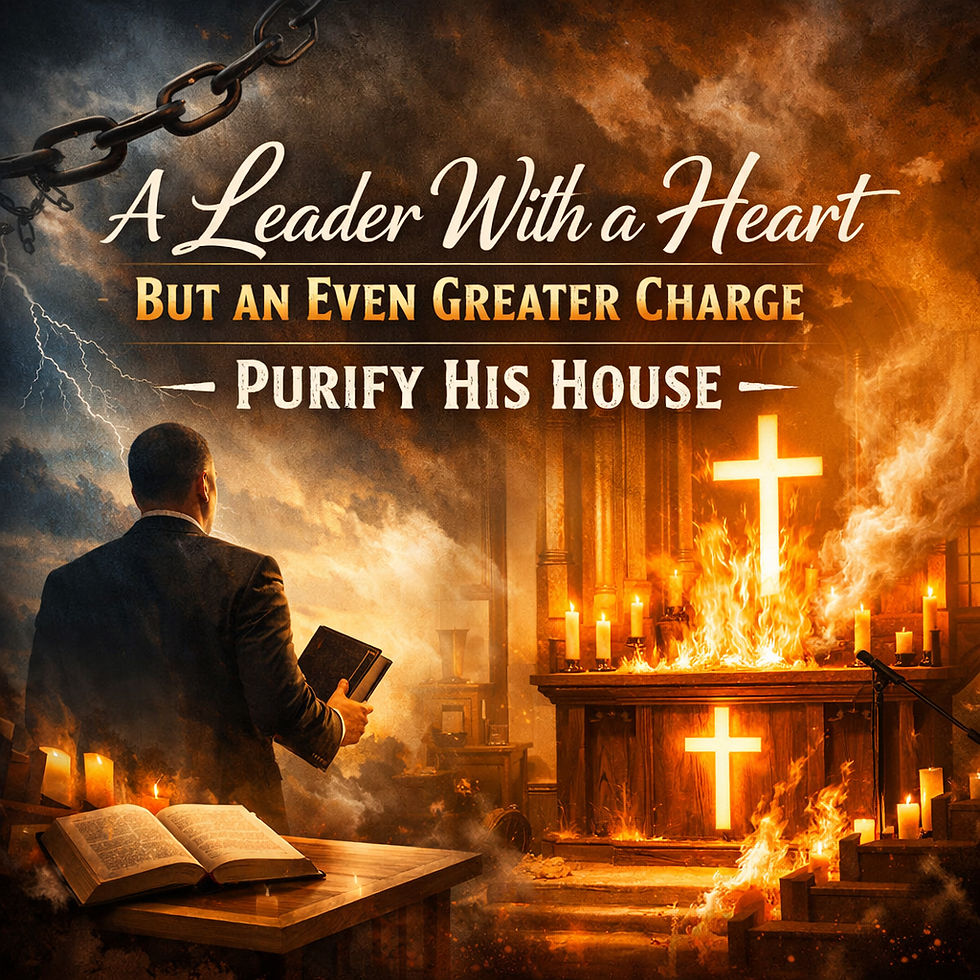
I’m a Leader With a Heart.. But an Even Greater Charge

Leadership in the Kingdom of God has never been for the faint of heart. It is not simply a title, a position, or a platform. It is a burden. It is a sacred assignment. It is a call that presses upon the soul long after the applause fades and the lights dim. Many people assume leadership is about visibility, influence, or recognition, but those who truly carry it know it is far heavier than that. Leadership in the house of God means you carry people, you carry vision, you carry responsibility, and above all, you carry accountability before God Himself. And in moments like the one we are living in right now, the Spirit of the Lord is reminding many of us who lead: you may have a heart for people, but you also have a charge from heaven.
One of the tensions leaders must learn to live with is the tension between compassion and correction. We love the people we lead. We pray for them. We labor for them. We intercede for them when no one else knows the battles they are facing. A true leader does not merely oversee people; they carry them in prayer and often in tears. The heart of a shepherd is tender toward the sheep. But tenderness cannot become tolerance for what God has called us to confront. And that is where many leaders find themselves wrestling today. We have hearts full of mercy, but we must also remember that we have been entrusted with a divine charge that cannot be ignored.
The Lord is speaking clearly in this hour to those who lead His people: do not become so compassionate that you abandon your responsibility. Mercy must never cancel obedience. Kindness must never silence truth. The moment a leader begins to prioritize comfort over consecration, the atmosphere of the house begins to shift. What once was holy becomes casual. What once was guarded becomes tolerated. And what is tolerated long enough will eventually become normalized. Leaders are not called to create environments that merely make people feel comfortable. Leaders are called to steward environments where the presence of God can dwell without compromise.
The weight of leadership is not simply in managing people; it is in guarding the culture of the house. Every church, every ministry, every spiritual community develops a culture. Culture is not defined by slogans or mission statements. Culture is defined by what is allowed, what is corrected, and what is celebrated. If pride is allowed, pride will become culture. If dishonor is ignored, dishonor will spread. If compromise is excused, compromise will become the standard. This is why leadership requires more than a loving heart, it requires courage. The courage to confront what others avoid. The courage to call out what others excuse. The courage to stand for holiness when the pressure to accommodate becomes overwhelming.
God is merciful toward leaders. He sees the internal battles we face. He knows the sleepless nights, the moments of self-doubt, the prayers whispered under our breath when the weight feels unbearable. He understands that many leaders genuinely love people and want to see them restored, healed, and whole. But even with all of that compassion, the Lord still holds leaders accountable for the charge placed upon their lives. The call to lead is not just an invitation to care for people; it is a commission to guard the integrity of the house of God.
Scripture repeatedly shows us that God takes the stewardship of His house very seriously. Throughout the Old Testament, priests were responsible for maintaining the sanctity of the temple. They could not allow what was unclean to remain within the sacred space. The reason was not because God lacked compassion for people, but because His presence demanded purity. The temple was not just a gathering place; it was a dwelling place for the glory of God. If the temple became contaminated, the presence of God would withdraw. Leaders today carry a similar responsibility. While the physical temple of old may no longer stand, the spiritual house, the community of believers, still requires guardians.
There are seasons when the Lord begins to stir leaders with a holy unrest. It is not anger toward people; it is grief over what has been allowed to remain unaddressed. It is the Spirit of God whispering, “Clean the house.” Sometimes leaders try to ignore that stirring because they do not want to hurt anyone’s feelings or disrupt the peace. But what appears to be peace on the surface can actually be spiritual stagnation underneath. When the Lord begins to call for purification, ignoring that call only prolongs the inevitable. Eventually God will deal with what leaders refused to confront.
The danger for many leaders is that they begin to confuse love with silence. Love does not mean ignoring sin. Love does not mean overlooking destructive behavior. Love does not mean pretending everything is fine when it clearly is not. True love is willing to tell the truth even when the truth is uncomfortable. A leader who refuses to correct simply because they want to be liked is not protecting the people, they are abandoning them. Correction is not cruelty; it is care. Discipline is not rejection; it is protection.
In fact, Scripture teaches that God disciplines those He loves. If the Father corrects His children, then leaders must understand that correction is part of the spiritual ecosystem of growth. A house where nothing is corrected eventually becomes a house where nothing is sacred. When leaders stop addressing issues, the boundaries that once protected the culture slowly erode. Eventually the atmosphere becomes so compromised that the very presence of God feels distant.
There is also a sobering reality that leaders must acknowledge: influence magnifies impact. When a regular member struggles with something, the effects may be limited. But when a leader carries unaddressed compromise, the damage spreads quickly. People look to leaders for direction, example, and guidance. Whether leaders realize it or not, their actions communicate permission. If a leader tolerates something in their own life or within the leadership culture, others will assume it is acceptable.
This is why the charge of leadership is so serious. It is not about perfection, but it is about integrity. Leaders must live in a posture of continual repentance and consecration. The altar must remain active in the life of the leader. A leader who stops visiting the altar eventually begins to lead from memory rather than from revelation. The fire that once burned brightly begins to dim, and slowly the culture of the house begins to reflect the leader’s drift.
Yet even in the midst of this sobering responsibility, the Lord is gracious. He does not call leaders to this charge without also extending mercy toward their hearts. God understands that leaders are human. We experience fatigue. We wrestle with emotions. We feel the tension between loving people and confronting difficult realities. The mercy of God is what sustains leaders in those moments. His mercy reminds us that we are not expected to carry the assignment alone.
However, mercy should never be mistaken for permission to neglect the charge. Mercy gives us strength to fulfill the charge, not an excuse to avoid it. When God extends mercy to leaders, it is often an invitation to realign with the assignment. It is His way of saying, “I still trust you with this responsibility, but you must return to the posture that honors the call.”
There are moments in leadership when the Lord calls us to confront what we hoped would correct itself. Many leaders quietly pray that certain issues will resolve on their own, that people will mature, or that problematic behaviors will fade away without intervention. Occasionally that does happen. But more often than not, unaddressed issues grow stronger with time. What begins as a small compromise eventually develops roots. And once something develops roots, removing it becomes far more difficult.
This is why the Spirit of God often prompts leaders with urgency: deal with it now. Address it while it is still manageable. Speak truth before the culture becomes contaminated. The goal of confrontation is not humiliation, it is restoration. When leaders call things out with wisdom and love, they create opportunities for healing and realignment. But when leaders avoid confrontation entirely, the damage continues quietly beneath the surface.
The phrase “purify His house” is not merely a dramatic declaration; it is a spiritual mandate. Purification means removing what does not belong so that what is holy can remain. In the natural world, purification often involves fire or refining processes that remove impurities from precious metals. The same principle applies spiritually. God sometimes allows seasons of exposure, correction, and realignment because He is refining His house.
Leaders are often the instruments through which that purification begins. Not because leaders are superior to others, but because they have been entrusted with oversight. The purification of the house begins with the purification of leadership. Before leaders can confront anything in the culture, they must first examine their own hearts. Self-examination is not weakness; it is wisdom. A leader who regularly asks God to search their heart remains sensitive to the Spirit’s conviction.
When leaders live in that posture of humility and accountability, they gain the authority to address issues within the house. Authority in the Kingdom is not derived from position, it is derived from alignment. When leaders align their hearts with God’s standard, their voice carries weight. People can discern when correction flows from genuine concern rather than from ego or control.
At the same time, leaders must accept that confronting issues will not always be received well. Some people will misunderstand the motive. Others will resist accountability. A few may even walk away. These realities can make leadership incredibly painful at times. But the call of God was never dependent on universal approval. Faithfulness to the charge must remain the guiding principle.
There is a profound difference between leading to be loved and leading to be faithful. When leaders prioritize being loved, they begin to make decisions based on how people will respond rather than on what God requires. But when leaders prioritize faithfulness, they anchor their decisions in obedience to the Lord. Ironically, faithful leadership often produces deeper respect in the long run, even if it creates temporary discomfort.
The house of God was never meant to function as a place where anything goes. It was designed to be a place where transformation occurs. Transformation requires truth. It requires accountability. It requires environments where people are lovingly challenged to grow beyond their current limitations. When leaders maintain that environment, the church becomes a place where people encounter not just encouragement but genuine change.
Ultimately, the call to leadership in the Kingdom is a call to steward both love and holiness simultaneously. The leader’s heart must remain compassionate toward people, but the leader’s conviction must remain unwavering toward truth. The two are not enemies; they are partners. Compassion without conviction produces compromise. Conviction without compassion produces harshness. But when the two work together, they produce healthy spiritual communities where people can encounter both grace and growth.
In this hour, many leaders are sensing the Spirit of God calling them back to the seriousness of their charge. The days of casual leadership are fading. God is restoring the fear of the Lord within His house. Not a fear rooted in terror, but a reverence that recognizes the holiness of God and the weight of stewardship entrusted to those who lead.
For leaders who have been wrestling with the tension between their heart for people and their responsibility to confront difficult realities, the Lord is offering clarity. You are not wrong for loving people deeply. In fact, that love is part of your calling. But your love must never cause you to abandon the charge God placed upon your life. The house must remain pure. The culture must remain aligned. And the truth must remain spoken.
You can be a leader with a heart and still uphold the charge. You can extend mercy while still requiring accountability. You can love people while still calling them higher. These are not contradictions, they are the very essence of Kingdom leadership.
So leaders, do not be dismayed. Do not allow the tension of this season to discourage you. If the Lord is stirring you to address issues, to confront compromise, or to purify the culture of the house, understand that He is entrusting you with something sacred. The weight you feel is not punishment; it is responsibility.
Lead with compassion. Lead with courage. Lead with clarity. But above all, lead with obedience to the One who called you. Because at the end of the day, the measure of leadership will not be how comfortable people felt, it will be how faithfully you guarded the charge.


Comments